Meeting planning for 2027: how to choose next year's locations
Plan your 2027 meetings from where participants travel from: a checklist for choosing locations, using 2026 as a baseline and keeping the same budget.
By Convien teamPublished 3 min read
The best time to choose the locations for your 2027 meetings is now, before dates and venues are fixed. Choose each location from where the participants travel from, and you lock in lower travel cost, less travel time and less CO2 for the whole year.
Why 2027 planning starts with locations, not venues
Most annual meeting plans start with a calendar and a list of venues. The location usually follows habit: headquarters, last year's city or wherever the organiser sits. Yet the location sets the travel bill for every participant, long before anyone books a flight or a hotel room.
Once dates and venue contracts are signed, the location is fixed for the year. Deciding it with data first is the cheapest correction you can make. With our clients, a better location means up to 35% lower travel cost and up to 42% less CO2.
A checklist for your 2027 meeting calendar
List every recurring meeting. Sales kick-offs, regional meetings, project reviews, trainings and retreats. Note who attends and roughly how many.
Record where participants travel from. A city, postcode or airport per group is enough. No names or other personal data are needed.
Shortlist candidate cities. Three to five realistic options per meeting, based on venues, budget and your travel policy.
Compare on real connections. Real fares and schedules, rail and road, door-to-door time and extra hotel nights. Averages and gut feeling hide the differences.
Decide what matters for each meeting. Lowest ticket cost, least CO2 or least time on the road. A retreat and a large training may not need the same answer.
Check the dates too. Trade fairs and city events push up hotel prices. Alternative dates can change cost and CO2 as much as the city does.
Book early where the location is clear. Once the location is decided, you can secure venues and hotel blocks in good time.
Same budget, more meetings
Planning the year as a whole shows what single decisions hide. At a client in the pharmaceutical industry, 32% lower travel and hotel cost per meeting paid for 47% more meetings with the same budget. The meetings did not get shorter or smaller. They got better locations.
Use 2026 as your baseline
Your 2026 meetings already tell you a lot: which cities you used most, how many participants travelled and what each meeting cost. A retrospective analysis compares each past location with the best alternatives and shows where the largest savings for 2027 are.
One example: for a DAX-listed company we analysed 219 meetings with 5,652 participants. The better locations avoided about 1,170 t of CO2 and saved over EUR 1M in travel spend.
How the Meeting Place Finder helps
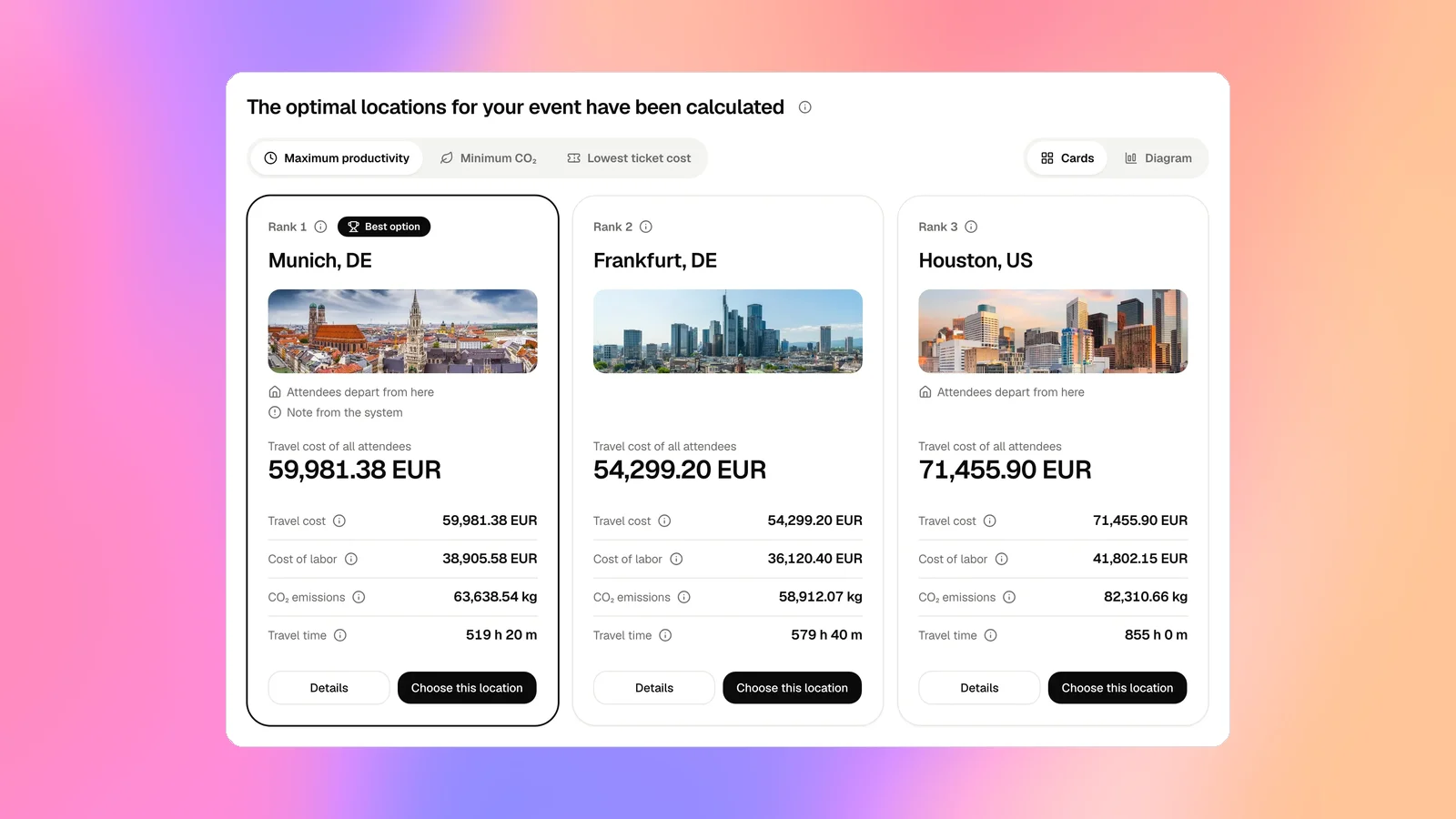
The Meeting Place Finder ranks every candidate city for your participants side by side: real fares and schedules, rail and road connections, door-to-door travel time and CO2 according to the VDR standard. You choose the view: maximum productivity, minimum CO2 or lowest ticket cost. For the full method behind a single decision, read our guide on how to choose a meeting location.
You can try it for free for one event with up to 10 participants.
FAQ
When should we plan meeting locations for 2027?
As early as possible, ideally before venue contracts and dates are fixed. The location shapes the decisions that follow, from hotels to travel bookings.
Do we need participants' names to plan locations?
No. A city, postcode or airport per group is enough to compare locations.
How many cities should we compare per meeting?
Three to five realistic candidates are usually enough. Include at least one hub with good direct flights and rail connections.
Is the cheapest location also the one with the lowest CO2?
Often, but not always. Compare both and decide which matters most for each meeting.
Share this article
Read us first in Google Search.